
Buyers Shop With Their Eyes. Most Catalogs Still Ask Them to Read.
Buyers Shop With Their Eyes. Most Catalogs Still Ask Them to Read.
What Your Buyers Are Actually Looking For When They Open Your Catalog
In home furnishings and lighting, buyers decide by look and feel. Here's what that asks of a B2B wholesale site, with a recent example from John-Richard.
Ask a designer how she chose a credenza, and you will not hear a part number. You will hear that the client wanted warm brass, that the piece needed to read open without looking busy, and that it had to sit under a window without fighting the light.
That is how a great many sourcing decisions get made in home furnishings, lighting, and decor. It is not usually how B2B wholesale websites get built. Catalogs tend to be organized the way the back office thinks about them, by category, by collection, by SKU, which leaves the buyer to translate the picture in her head into terms the site will accept. Most buyers will do that translation once or twice. Far fewer will do it twenty times.
The quiet cost of one more click
Here is a pattern worth looking for on your own site. A buyer lands on a grid of thumbnails, one hero image per product. To learn anything the hero shot does not show, the finish up close, the lamp lit rather than dark, the cabinet open rather than closed, she has to open the product page, look, go back, and open the next one.
Five products in, that is ten page loads to answer a single question: which of these looks right?
No one gives up on a catalog because of one extra click. What wears people down is the twentieth click that still has not answered the question. And a buyer who runs out of patience rarely tells you. She simply finds what she needs somewhere faster, and you never learn that she was there.
Search works best when it speaks the buyer's language
The search bar is the second place this shows up. Wholesale buyers search the way they think, by color, by finish, by material, by how a piece is oriented. When search is built only on product names and category labels, those searches tend to return either nothing or everything, and both answers send the buyer back to scrolling.
In a small catalog, that is a minor annoyance. Once you are past a few thousand SKUs, attribute-level filtering is closer to the front door than a feature. It decides whether the catalog can be shopped by someone who has not already memorized it.
A recent example
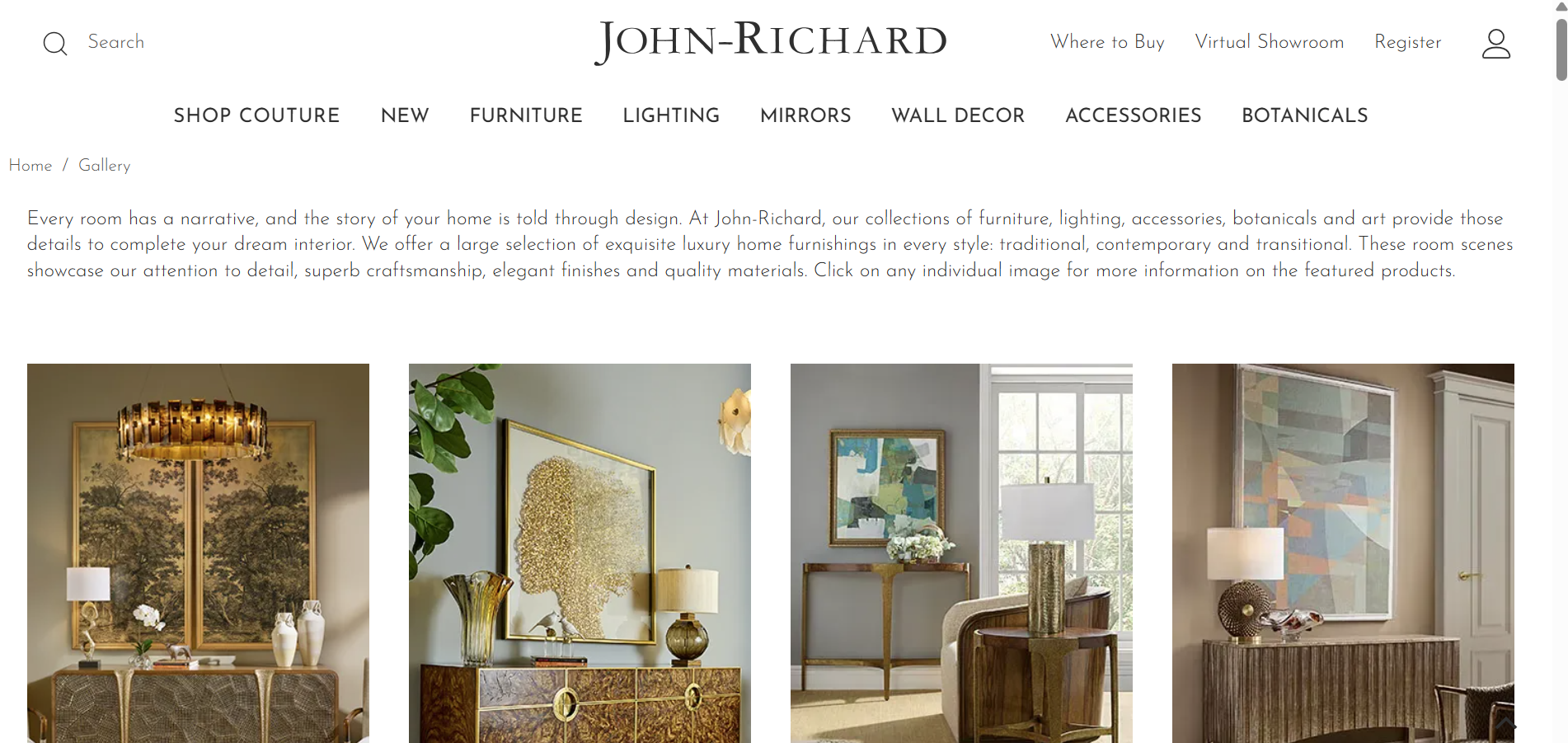
This is the problem our EMUN team set out to solve with John-Richard's new web platform, which debuted at Spring 2026 High Point Market. John-Richard has a large and beautifully detailed catalog, and its buyers, designers, retailers, and trade partners tend to arrive with a specific look already in mind.
Three things changed for them. High-resolution detail shots now open from the thumbnail view, so a buyer can compare a lamp on and off, or a credenza open and closed, without leaving the grid. An API-driven architecture powers filtering by color, finish, material, and orientation, so the search bar meets buyers where they are. And the pricing models and business logic John-Richard's partners depend on were left as they were. The buying experience changed. The commercial relationships did not.
That last piece tends to get the least attention and cause the most hesitation. In our experience, brands postpone these projects not because they doubt the website, but because of everything sitting underneath it: the pricing tiers, the partner terms, the order logic that took years to get right.
As Alan Moss, Enterprise Account Executive for MarketTime | EMUN, put it, the goal was "a site that matches the quality of their product and makes it easier for their customers to find exactly what they're looking for."
What buyers will likely ask for next
Expectations keep moving, and lately they are moving toward a search that tolerates ordinary human vocabulary. A buyer who types "antiqued gold" when the catalog says "aged brass" should still find the piece. So should the one who misspells it on the first try.
That is what comes next for John-Richard: AI-assisted search with synonym recognition and autocorrect, followed by the ability to switch between art sizes and frame types inside a single product view, so a buyer weighing options is not bouncing between listings to do it.
A gentle audit you can run this week
Pick your three best sellers and count the clicks it takes a buyer to answer the question she arrived with. If the number surprises you, it is worth a closer look, and the fix is often smaller than it sounds. The photography usually exists already. The attribute data usually exists already. More often than not, it is the storefront that has not caught up with either one.
You can see the new John-Richard site at johnrichard.com, and the full announcement in our newsroom.
EMUN builds custom B2B wholesale websites for manufacturers and multi-line sales agencies, with AI-powered search, multi-line ordering, commissioning, CRM, and reporting. Learn more.